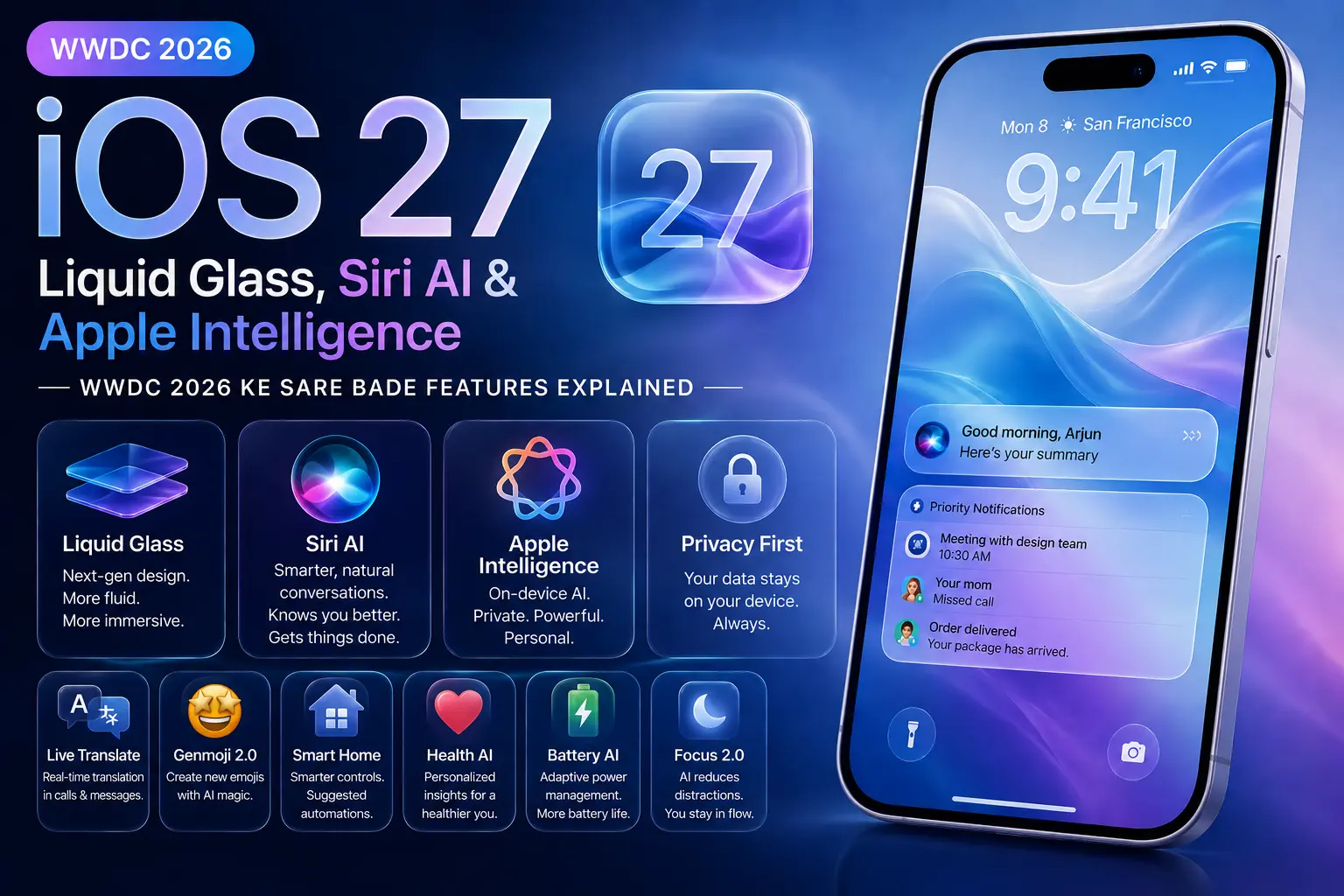
iOS 27 arrives on Monday, September 14, 2026, and it is one of Apple's biggest software updates in years. The headline feature is Siri AI, a rebuilt assistant that finally feels conversational, but the update also refines the Liquid Glass design, adds new parental controls, speeds up everyday tasks, and improves Photos, Messages, Maps, and Find My. This guide breaks down every major change in plain language.
Apple first showed iOS 27 at WWDC in June 2026 and spent the summer polishing it through public betas. Unlike some past updates that focused mainly on new apps, iOS 27 is built around two goals: making Apple Intelligence genuinely useful through Siri AI, and making the whole system feel faster and safer, especially for families. Here is everything included.
1. Siri AI: The Biggest Change in iOS 27
Siri AI is Apple's redesigned assistant, and it is the standout feature of iOS 27. Instead of short, rigid replies, Siri AI can hold a real conversation. It remembers earlier questions in the same chat, accepts follow-up questions, and lets you type instead of speaking if you'd rather stay quiet.
Siri AI also gets deeper access to your personal context, meaning it can pull details from your calendar, messages, and files to answer questions more accurately. A new System Orchestrator connects Apple Intelligence features across apps, so Siri can complete multi-step requests instead of just answering one question at a time. Some processing happens entirely on your iPhone, while more demanding requests are handled through Apple's Private Cloud Compute servers, which are designed so Apple cannot read your data.
Where Siri AI Falls Short
Siri AI needs an iPhone 15 Pro, iPhone 15 Pro Max, or any iPhone 16 model or newer. Older supported iPhones, like the iPhone 11 through iPhone 14 series, still get iOS 27, just without Siri AI. On top of that, Siri AI will not be available in the European Union at launch because of Digital Markets Act rules, and it is also unavailable in China.
2. Visual Intelligence Moves Into the Camera App
Visual Intelligence, the feature that lets your iPhone identify objects and answer questions about what your camera sees, now lives inside a dedicated Siri mode in the Camera app. Open the camera, point it at something, and Siri can look up nutrition facts on food, pull details about a landmark, or search the web for a product you're looking at. You can also attach a screenshot or a photo directly to a Siri question for extra context.
3. Liquid Glass Gets Easier to Read
Apple introduced its translucent Liquid Glass design in iOS 26, and reactions were mixed. iOS 27 keeps the same look but fixes the biggest complaints:
- More uniform refraction and stronger contrast make text easier to read over busy backgrounds
- App icons gained extra layers of glass for more depth and sharper detail
- Navigation bars, menus, and buttons now stand out more clearly from the content behind them
- A new slider in Settings lets you choose how see-through the effect looks, from fully clear to a more solid, tinted style
If you found Liquid Glass distracting in iOS 26, the new slider is the fastest way to tone it down without losing the visual style entirely.
4. Performance Improvements Across the Board
Apple spent real effort on speed this year, and it shows in small, noticeable ways rather than one big headline feature. In iOS 27:
- Apps launch faster, even on older supported iPhones
- AirDrop transfers complete quicker
- The keyboard loads with less delay
- Switching between Home Screen pages feels smoother
- App Library opens faster
A new CPU scheduler decides which tasks get priority processing power, keeping background activity running without slowing down whatever you're actively doing. This is also likely why iOS 27 still supports the iPhone 11, a phone from 2019 that struggled with some of Liquid Glass's rendering demands in iOS 26.
5. Stronger Parental Controls
Child safety is one of the biggest focus areas in iOS 27, and Apple redesigned parental controls from the ground up.
Time Allowances
Parents can now set a shared screen time limit that applies across all apps, then fine-tune limits for specific categories like games, social media, and entertainment. Schedules can also change by day or by time of day.
Ask to Browse
This expands the existing Ask to Buy feature beyond the App Store. Before a child can visit a new website, they now have to send a request for approval, similar to asking permission to download an app.
Simplified Child Accounts
Setting up a Child Account is faster, and parents get an at-a-glance view in Settings showing how their child has used their iPhone recently. Adjusting permissions takes just a tap instead of digging through several menus.
Communication Safety Upgrades
Communication Safety, the feature that warns kids about sensitive photos in Messages, can now detect and obscure graphic imagery as well, expanding protection beyond its original scope.
6. Photos Gets AI Editing Tools
The Photos app picks up two Apple Intelligence features aimed at fixing awkward crops:
- Extend: generates realistic new image content beyond a photo's original edges, useful for filling a Lock Screen wallpaper that doesn't quite match your iPhone's aspect ratio
- Spatial Reframe: lets you shift the apparent angle of a photo after it's taken, which can rescue an image where the subject is off-center
Image Playground, Apple's on-device image generator, also gains new styles, including support for more photorealistic results.
7. Messages, Mail, and Maps Get Quieter Upgrades
A handful of smaller changes make daily messaging and browsing smoother:
- Messages: large photos and videos no longer delay the text sent alongside them, outgoing messages show a clear send indicator, Tapback notifications are grouped together instead of arriving one by one, and Apple Intelligence suggests helpful actions like attaching a photo or sharing your location
- Mail and Safari: Apple Intelligence helps summarize and organize content, and Safari adds a "Notify Me" tool that watches a webpage for changes on your behalf
- Maps: Flyover now uses Apple Intelligence models to sharpen aerial imagery, giving buildings, trees, and landmarks more realistic texture and more accurate shapes
8. Find My Adds More Control Over Your Location
Find My now lets you share your location for a custom length of time or until a specific moment you choose, rather than only "until turned off." A new Hide Location option quietly stops sharing your location with a specific person without alerting them. The whole Find My interface has also been refreshed to match the updated Liquid Glass look.
9. iPhone Handoff: Two Phones, One Number
iPhone Handoff is a new feature that lets you switch between two iPhones while keeping the same phone number active on each device. Apple has not detailed every use case, but it appears aimed at people who temporarily use a second iPhone, such as switching to a backup phone for travel or testing.
10. Small Details That Add Up
Beyond the headline features, iOS 27 includes several smaller changes worth knowing about:
| Feature | What It Does |
|---|---|
| New battery icon | A redesigned status bar battery indicator |
| Large widgets | Extra-large Home Screen widgets for Calendar, Photos, and Music |
| Custom Wallet passes | Create your own passes in Wallet for things Apple doesn't officially support |
| Bill splitting | A built-in way to split a shared bill between people |
| Keyboard clipboard tools | Faster access to recently copied text and images while typing |
| Independent alarm/timer volume | Set alarm and timer sounds separately from your ringer volume |
iOS 27 Compatibility: Which iPhones Get It?
iOS 27 supports the same range of iPhones as iOS 26, so most people already running last year's update will be able to install it. Here's the breakdown:
- Full update with performance and design changes: iPhone 11 and newer, including the iPhone SE (2nd generation) and later
- Siri AI and the newest Apple Intelligence features: iPhone 15 Pro, iPhone 15 Pro Max, and all iPhone 16 models and newer
If you own an older supported iPhone, you'll still get faster app launches, the updated Liquid Glass slider, new parental controls, and smaller quality-of-life fixes. You just won't get Siri AI or the AI-powered Photos tools that depend on more powerful on-device chips.
Should You Update to iOS 27?
For most people, yes. The performance improvements alone make it worth installing, since apps open faster and the system feels more responsive, even on hardware from several years ago. Families will also benefit from the new parental control tools, which are some of the most detailed Apple has shipped.
The one group that should hold off briefly is anyone relying on a specific app for work who wants to wait a week or two for developers to confirm full compatibility with the new Liquid Glass keyboard behavior. Everyone else can update as soon as it becomes available on September 14.
People Also Ask
Summary
iOS 27 is a rare update that improves nearly every part of the iPhone experience at once. Siri AI is the headline addition, giving Apple a real answer to conversational assistants, though it's limited to newer iPhones and a handful of regions at launch. Beyond that, iOS 27 quietly fixes Liquid Glass, speeds up daily tasks, and gives parents far more detailed control over how their kids use their devices. Whether you're running the latest iPhone Duo or an aging iPhone 11, this update is worth installing the moment it lands on September 14.
For more on Apple's newest hardware, check out our Apple iPhone Duo review, see how it compares in our iPhone 18 Pro review, browse our guide to the best foldable phones of 2026, or compare Apple's foldable against the competition in our Samsung Galaxy galaxy s26 ultra review.
For Apple's own feature breakdown, visit the official iOS 27 page.